
This is a strong companion to the previous article because:
Previous blog: Why your DIY workout plan fails because of programming, progression, form, plateaus, etc.
New blog: Even if you know what to do, why do people still fail to stay consistent, and how does having a personal trainer change that?
There is also much stronger recent research we can use. A 2025 randomized controlled trial comparing supervised, app guided, and self guided resistance training found adherence was 88.2% in the supervised group versus 52.2% in the self guided group. All groups improved strength, but the supervised group had greater squat strength improvements. Another study found that supervised resistance training produced greater muscular adaptations and improved adherence among resistance trained individuals.
So this gives us a very data driven article, similar to the style of the blog your boss likes, without recycling the exact same argument.
Why Motivation Isn’t Enough: How a Personal Trainer Helps You Stay Consistent and Reach Your Fitness Goals
You probably already know what you need to do.
You know that exercise is important.
You know that strength training can help you build muscle and become stronger.
You know that regular physical activity is an important part of a healthy lifestyle.
You may even have a gym membership, a workout app on your phone, and a collection of saved fitness videos ready to go.
So why is it still so difficult to stay consistent?
This is one of the most frustrating parts of trying to improve your fitness. The information is available. The equipment is available. The workouts are available. You may even have the motivation to get started.
Yet weeks or months later, you find yourself back in the same position.
You start strong.
You train consistently for a few weeks.
Something changes in your schedule.
You miss a workout.
Then you miss another.
Eventually, the routine disappears.
When motivation returns, you start again.
This cycle can continue for years.
The problem is not necessarily that you are lazy or that you do not care about your health. In many cases, the problem is that motivation is being asked to do a job it was never designed to do.
Motivation can help you start.
It cannot always make you continue.
That is where structure, accountability, professional guidance, and consistency become important.
A personal trainer does not simply provide exercises. One of the biggest benefits of personal training is having another person involved in the process who helps turn your intentions into a routine you can actually follow.
And recent research gives us a compelling reason to take that difference seriously.
A 2025 randomized controlled trial compared supervised resistance training with app guided and self guided training among 79 trained men and women over 10 weeks. Adherence was highest in the supervised group at 88.2%, compared with 81.2% for app guided training and 52.2% for self guided training. The supervised group also demonstrated greater improvements in squat strength than the other two groups.
The lesson is not that you cannot succeed on your own.
You absolutely can.
The lesson is that having someone guide and supervise the process can make it easier to consistently execute the work required to reach your goals.
So what is actually happening when a personal trainer becomes part of that process?
Motivation Is a Great Starting Point, But It Is a Poor Long Term Strategy
Most fitness journeys begin with motivation.
You see a goal you want to achieve.
Maybe you want to lose weight.
Maybe you want to build muscle.
Maybe you want to feel stronger.
Maybe you want to improve your health.
Maybe you simply want to stop feeling out of shape.
Whatever the goal, there is usually an emotional moment that creates the decision to start.
You buy workout clothes.
You sign up for a gym.
You search for a workout.
You decide that this time will be different.
And for a while, it feels easy.
The problem is that motivation naturally changes.
Motivation Changes With Your Life
You may feel extremely motivated on Monday.
By Friday, you may have had a difficult week at work.
You may have slept poorly.
You may have spent the entire day dealing with responsibilities.
You may simply feel tired.
Your fitness goal has not changed, but your emotional state has.
This is why building a fitness routine entirely around motivation can be difficult.
Your ability to exercise should not depend on whether you feel excited about exercising that day.
A sustainable routine needs something stronger than temporary motivation.
It needs structure.
Consistency Is What Turns Effort Into Progress
One excellent workout does not transform your body.
One healthy meal does not transform your body.
One week of exercise does not create a long term fitness habit.
Results come from repeatedly performing the behaviors that support your goal.
That means showing up when you are motivated and when you are not.
It means continuing after the initial excitement disappears.
It means having a system that makes exercise part of your routine rather than something you constantly have to decide whether you feel like doing.
This is one area where personal training can provide significant value.
The Accountability Advantage: Someone Else Knows You Are Supposed to Show Up
One of the simplest benefits of having a personal trainer is also one of the most powerful.
Someone is expecting you.
When you train completely alone, skipping a workout is easy.
There is no appointment to cancel.
There is no coach waiting for you.
There is no one asking why you did not show up.
You can tell yourself you will train tomorrow.
Sometimes tomorrow works.
Sometimes tomorrow becomes next week.
A Scheduled Session Creates Commitment
Personal training turns exercise into an appointment.
You have a specific time.
You have a specific session.
You have a specific person waiting for you.
That changes the decision you have to make.
Instead of asking yourself, “Do I feel motivated enough to work out today?”
You already have a commitment on your calendar.
That distinction may seem small, but it can matter enormously for people who repeatedly struggle with consistency.
Accountability Is Different From Pressure
Good accountability should not make you feel guilty for missing a workout.
It should help you stay connected to the goal.
A trainer can help you recognize patterns.
Maybe you consistently struggle to train after long workdays.
Maybe mornings work better for you.
Maybe you tend to miss workouts when your schedule becomes unpredictable.
Maybe you are trying to do too much and becoming burned out.
Understanding those patterns allows you to make better decisions.
The goal is not perfection.
The goal is creating a routine you can realistically maintain.
The Research: Does Supervision Actually Improve Adherence?
This is where the argument for professional guidance becomes particularly interesting.
A 2025 randomized controlled trial published in the Journal of Strength and Conditioning Research compared three resistance training approaches: in person supervised training, app guided training, and self guided training using a PDF program.
The participants completed a 10 week resistance training program three times per week.
The difference in adherence was substantial.
The supervised group completed training with an adherence rate of 88.2%.
The app guided group recorded 81.2% adherence.
The self guided group recorded 52.2% adherence.
All three approaches produced improvements, which is important.
This was not a study showing that independent training is useless.
The self guided participants still benefited from exercise.
What changed was the degree to which participants consistently followed the program.
That distinction is incredibly relevant to real life.
The Best Workout Cannot Help If You Do Not Do It
Imagine having the perfect workout program.
It is scientifically sound.
It is appropriate for your goal.
It includes the right exercises.
It has a thoughtful progression strategy.
But you only complete half of the sessions.
The program cannot produce the same outcome because it is not being consistently executed.
This is why adherence is such an important part of fitness.
The quality of the program matters.
But so does your ability to follow it.
A Personal Trainer Helps Remove the Daily Decision Making
One of the hidden reasons people struggle with fitness is decision fatigue.
Every workout requires decisions.
Should I train today?
What exercises should I do?
How many sets?
How many repetitions?
How much weight?
Should I do cardio?
Should I increase the weight?
Should I rest?
Should I change my workout?
When you make every decision yourself, exercise becomes another responsibility competing for your attention.
Personal training simplifies that process.
You Know What You Are Doing Before You Walk Into the Gym
Instead of arriving at the gym and trying to decide what your workout should be, you already have a plan.
Your trainer knows what you are working on.
You know what the session is designed to accomplish.
You can focus on performing the work rather than constantly planning the work.
That can make exercise feel significantly more manageable.
Less Guesswork Can Mean More Consistency
The fewer unnecessary decisions you have to make, the easier it can be to maintain a routine.
This does not mean personal training eliminates every obstacle.
It means you have a system that reduces the amount of planning you have to do yourself.
For a busy professional, that can be extremely valuable.
You do not need to spend your lunch break searching for a new workout.
You do not need to decide which exercises to combine.
You do not need to wonder whether you should increase your weight.
You can show up and execute the plan.
Personal Training Gives You Someone Who Can Adjust the Plan When Life Changes
Fitness does not happen in a vacuum.
Your schedule changes.
Your stress levels change.
Your sleep changes.
Your energy changes.
Your goals change.
Your body changes.
A rigid workout plan does not always account for those changes.
Your Program Needs to Work With Your Real Life
Suppose you normally train four days per week.
Then your work schedule changes and suddenly four sessions are difficult to maintain.
A DIY program may make you feel like you are failing because you cannot follow it exactly.
A trainer can look at the situation differently.
Maybe three well structured sessions make more sense.
Maybe certain sessions need to be shorter.
Maybe training days need to move.
Maybe the program needs to be temporarily adjusted.
The goal is not to force your life to fit the workout.
The goal is to make the workout fit realistically into your life.
A Trainer Can Help You Avoid the All or Nothing Mentality
Many people approach fitness in extremes.
If they cannot complete their full workout, they decide there is no point in going.
If they miss one day, they feel like they have failed.
If they eat one meal that does not fit their plan, they decide the entire day is ruined.
A good coach can help replace that all or nothing thinking with a more sustainable approach.
One missed workout does not destroy your progress.
One difficult week does not erase months of work.
The important thing is getting back to the process.
A Personal Trainer Provides Real Time Feedback You Cannot Get From an App
Technology can provide useful fitness guidance.
Apps can track workouts.
Videos can demonstrate exercises.
Wearables can monitor activity.
But none of those tools can fully replace having an experienced professional watching you perform an exercise in real time.
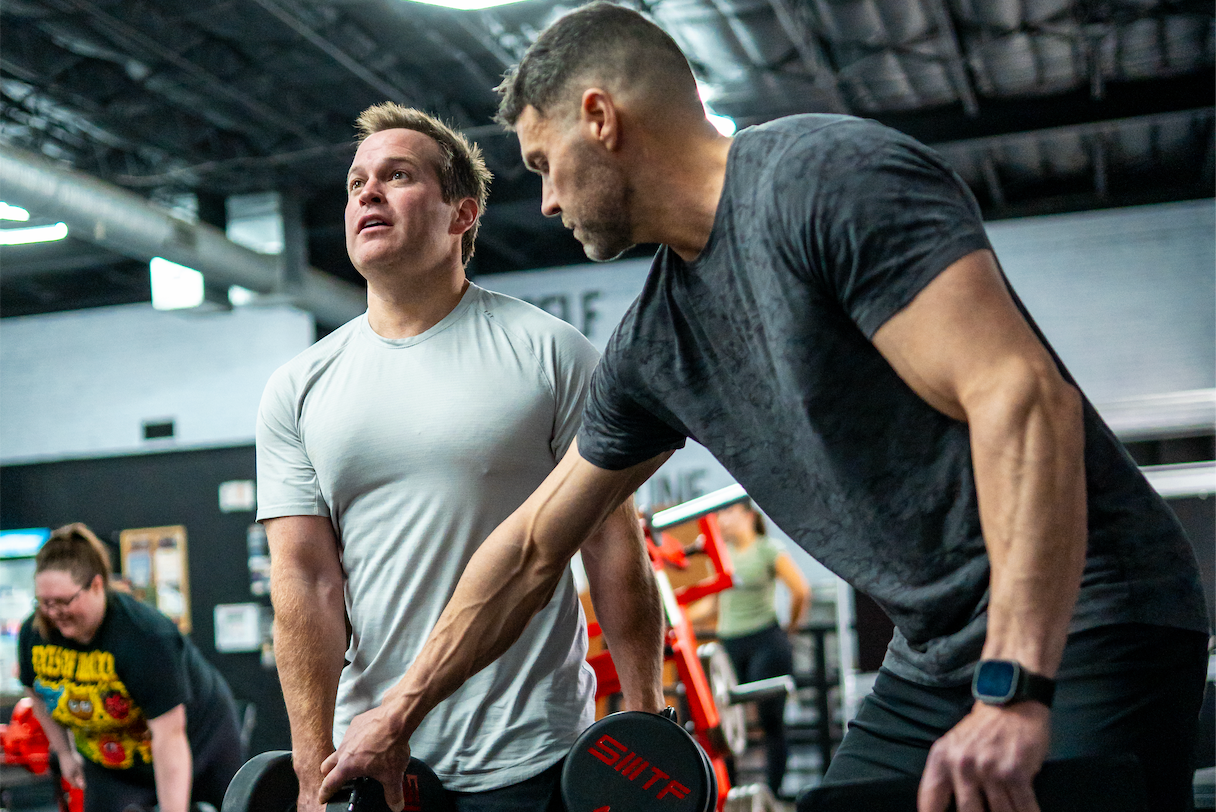
Your Trainer Can See What You May Not Notice
You may believe your technique looks correct.
Your trainer may notice something completely different.
They may see that your range of motion changes as you fatigue.
They may notice that your positioning changes between repetitions.
They may recognize that you are compensating with another part of your body.
They can then provide feedback immediately.
This creates a continuous feedback loop.
You perform.
Your trainer observes.
Your trainer provides feedback.
You adjust.
You perform again.
Over time, that coaching can help you develop better movement awareness.
Coaching Becomes More Valuable as Training Gets Harder
When an exercise is easy, small technique mistakes may not be obvious.
As resistance increases, those mistakes can become more noticeable.
A trainer can help you understand when increasing the weight is appropriate and when maintaining control is more important.
That distinction matters because progress is not simply about moving heavier weights.
It is about improving performance while maintaining quality.
A Trainer Helps You Know When to Push and When to Pull Back
Another challenge of training alone is determining how hard you should work.
Some people do not push themselves enough.
Others push themselves too much.
Both can create problems.
Some People Consistently Undertrain
You may finish every workout feeling comfortable.
You rarely challenge yourself.
You always use the same weights.
You stop every set long before meaningful effort.
You may be exercising consistently, but your body may not be receiving an appropriate challenge for your goal.
A trainer can help you understand when it is appropriate to increase the demand.
Other People Consistently Overtrain
The opposite problem is also common.
You train hard every day.
You constantly add more exercises.
You rarely take recovery seriously.
You assume that soreness means you had a good workout.
Eventually, your performance may suffer.
A trainer can help create a better balance between training stress and recovery.
The objective is not to make every workout as difficult as possible.
The objective is to make the training productive.
Personal Training Can Help You Stay Focused When Results Take Time
One of the hardest parts of fitness is that the results you want may take longer than your motivation expects.
You may work consistently for weeks without seeing a dramatic visual difference.
That does not necessarily mean nothing is happening.
Your strength may be improving.
Your technique may be improving.
Your fitness capacity may be improving.
Your habits may be becoming more consistent.
Those changes can happen before a major physical transformation becomes obvious.
Progress Is More Than What You See in the Mirror
A trainer can help you recognize different forms of progress.
Maybe you are lifting more weight.
Maybe you can perform more repetitions.
Maybe your endurance has improved.
Maybe your movement quality is better.
Maybe you are more consistent.
Maybe exercises that once felt difficult now feel manageable.
These improvements matter.
If the only measurement you use is the scale or the mirror, you can overlook meaningful progress and become discouraged.
The Confidence Effect: Knowing What You Are Doing Changes the Gym Experience
Walking into a busy gym can be intimidating.
There are machines you have never used.
There are exercises you do not understand.
There are experienced people lifting weights around you.
You may worry that you are performing something incorrectly.
You may feel like everyone is watching you.
That uncertainty can make it easier to avoid the gym altogether.
A Trainer Gives You Direction
When you know exactly what you are doing, the gym becomes less intimidating.
You have your exercises.
You know the technique.
You know the purpose.
You know what comes next.
Over time, that familiarity can build confidence.
You are no longer simply someone trying to figure out the gym.
You become someone who understands how to train.
Confidence Can Support Long Term Independence
The goal of personal training does not have to be making you dependent on a trainer.
A strong coaching relationship can actually help you become more independent.
You can learn why exercises are selected.
You can learn how progression works.
You can learn how to structure sessions.
You can learn how to recognize quality movement.
You can learn how to make better decisions about your own training.
That knowledge can remain valuable even if you eventually decide to train independently.
What Happens When You Have a Bad Week?
This is where the difference between motivation and structure becomes particularly important.
Everyone has bad weeks.
You may miss a session.
You may travel.
You may eat differently than planned.
You may sleep poorly.
You may feel stressed.
The question is not whether these things will happen.
They will.
The question is what happens afterward.
Without Accountability, One Missed Workout Can Become a Month
It is easy to think:
“I missed today. I’ll go tomorrow.”
Then tomorrow becomes Friday.
Friday becomes next Monday.
Eventually, you are no longer following the routine.
A trainer can help interrupt that pattern.
The goal is not to punish you for missing a session.
It is to help you return to the routine instead of abandoning it.
Consistency Does Not Mean Perfection
A sustainable fitness journey is not one where everything goes perfectly.
It is one where you continue moving forward despite the inevitable disruptions.
A personal trainer can help keep your attention on the larger process rather than allowing one difficult day to become a reason to quit.
What the Research Says About Supervised Training Beyond Accountability
The benefits of supervision are not limited to simply getting people through the door.
Research has also examined whether supervision affects physical outcomes.
A study published in the Journal of Sports Sciences compared supervised and unsupervised resistance training among resistance trained individuals over eight weeks. The researchers found that the supervised group generally experienced greater increases in muscle thickness at several measured sites, and the supervised group also showed a greater improvement in squat one repetition maximum. The study concluded that supervised resistance training promoted greater muscular adaptations and enhanced exercise adherence in the participants studied.
Again, this does not mean every person who hires a trainer will automatically achieve better results than every person who trains alone.
The details of the program, the quality of coaching, individual differences, nutrition, recovery, and consistency all matter.
But it does demonstrate why supervision can be more than simply having someone present in the room.
The Personal Trainer Advantage Is the Combination of Small Things
There is rarely one single reason why someone succeeds with personal training.
It is usually the combination.
You have a plan.
You have a schedule.
You have accountability.
You receive coaching.
You get feedback.
Your progress is tracked.
Your program can be adjusted.
You have someone helping you stay focused.
Each individual benefit may seem relatively small.
Together, they create a very different training experience.
Structure
You know what you are supposed to do.
Accountability
You have someone expecting you to show up.
Coaching
You receive feedback while you train.
Progression
Your training changes as you improve.
Adaptation
Your program can change when your circumstances change.
Perspective
Someone else can help you evaluate your progress objectively.
That combination is difficult to reproduce when you are completely responsible for every part of your fitness journey.
Who Benefits Most From Having a Personal Trainer?
Personal training can benefit many different types of people.
You do not need to be a beginner.
You do not need to be an athlete.
You do not need to have a specific body composition goal.
The common factor is that you want more structure, guidance, or accountability than you are currently getting on your own.
People Who Keep Starting Over
If you have started multiple workout programs but struggle to maintain them, accountability may be more valuable than another new routine.
People With Busy Schedules
If your calendar is already full, having a structured appointment and predetermined workout can remove some of the planning burden.
People Who Lose Motivation Quickly
If your motivation disappears after the first few weeks, a coaching relationship can help you stay connected to the process even when the initial excitement fades.
People Who Have Hit a Plateau
If you have been training consistently but your progress has stalled, having an experienced professional evaluate your approach can provide a perspective you may not have on your own.
People Who Want a Specific Outcome
If you have a specific goal, having a professional help structure your training around that outcome can make the process more intentional.
Is Personal Training Worth It If You Already Know How to Exercise?
This is an important question.
If you already understand exercise programming, know how to perform your movements correctly, track your progress, manage your recovery, and consistently follow your plan, you may not need a trainer for every workout.
But there is another question worth asking.
Could having a coach make the process easier, more consistent, or more effective?
Even experienced gym goers can benefit from an outside perspective.
You may know how to train but still struggle to stay consistent.
You may understand programming but have difficulty objectively evaluating your own performance.
You may know what you should be doing but struggle to make time for it.
You may simply perform better when you know someone is expecting you to show up.
Personal training is not only about teaching someone how to exercise.
It can also be about creating an environment where following through becomes easier.
The Cost of Personal Training vs. the Cost of Starting Over
The financial cost of personal training is obvious.
The cost of repeatedly starting and stopping is less obvious.
Consider how many times you may have bought a gym membership and stopped using it.
Consider how many workout programs you have started and abandoned.
Consider the equipment you may have purchased.
Consider the months spent exercising without knowing whether your approach was actually working.
Consider the frustration that comes from repeatedly setting goals and feeling like you are starting over.
Personal training is an investment.
But for the right person, the value may come from helping turn inconsistent effort into a consistent process.
You Are Investing in Follow Through
A workout program has no value if it stays on your phone.
A gym membership has no value if you rarely go.
A fitness goal has no value if you continually postpone taking action.
The value comes from execution.
That is one reason accountability can be such an important part of coaching.
You Do Not Need More Motivation. You May Need a Better System.
If you have repeatedly told yourself that you need to become more motivated, consider a different possibility.
Maybe motivation is not the missing piece.
Maybe structure is.
Maybe accountability is.
Maybe having someone guide you is.
Maybe you need a program that fits your schedule instead of one that looks impressive on paper.
Maybe you need someone who can help you adjust when life gets complicated.
Maybe you need someone who can recognize progress that you are not noticing yourself.
The solution is not always to try harder.
Sometimes the solution is to stop relying entirely on willpower.
How Vantage Elite Fitness Helps Dallas Clients Stay on Track
At Vantage Elite Fitness, personal training is designed to provide more than a list of exercises.
The approach combines individualized programming, coaching, accountability, and ongoing adjustments to create a structured training experience for each client.
The facility is located in the Dallas Design District and provides a private 14,000 square foot training environment where clients can focus on their workouts without the distractions commonly associated with large commercial gyms.
The goal is to help clients understand where they are starting, establish where they want to go, and create a realistic process for getting there.
That process matters because fitness is not simply about knowing what exercises exist.
It is about consistently executing the right behaviors over time.
Ready to Stop Relying on Motivation Alone?
You do not have to wait until you feel motivated to start taking your fitness seriously.
You can create a system that makes consistency easier.
You can have a structured program.
You can have someone keeping you accountable.
You can receive coaching while you train.
You can have your program adjusted as you progress.
And you can have a professional helping you stay focused when motivation naturally rises and falls.
If you are in Dallas and have been struggling to stay consistent with your workouts, personal training may provide the structure and accountability you have been missing.
[BOOK YOUR FREE PILOT SESSION NOW]
Frequently Asked Questions About Personal Training and Consistency
Why is it so hard to stay consistent with working out?
Consistency can be difficult because motivation naturally changes and exercise competes with work, family responsibilities, travel, stress, and other priorities. Having a structured schedule and accountability can make it easier to maintain exercise as a regular part of your routine.
Do I really need a personal trainer to stay motivated?
Not necessarily. Many people can stay motivated and train successfully on their own. A personal trainer can provide something different from motivation alone: structure, accountability, professional guidance, and a scheduled commitment that can help you continue training when motivation is low.
Does personal training improve workout consistency?
Research suggests that supervision can improve adherence. A 2025 randomized controlled trial found adherence of 88.2% in a supervised resistance training group compared with 52.2% in a self guided group over 10 weeks.
What if I already know how to work out?
You can still benefit from personal training even if you know the basics. A trainer can provide an outside perspective, help evaluate your program, provide technique feedback, manage progression, and create accountability.
Can a personal trainer help me if I keep quitting my workouts?
Yes. If consistency is your biggest challenge, accountability may be one of the most valuable aspects of personal training. A trainer can help create scheduled sessions and a realistic training structure that makes it easier to stay engaged with your goal.
Does having a personal trainer guarantee better results?
No. Personal training is not a guarantee of a specific physical transformation. Results depend on many factors, including training consistency, nutrition, recovery, individual circumstances, and the quality of the program. Research does suggest supervised resistance training can provide advantages for certain performance and strength outcomes.
Is personal training only useful for beginners?
No. Experienced gym goers can benefit from professional coaching as well, especially if they have reached a plateau, want to pursue a specific goal, need accountability, or want another professional perspective on their training.
Can a personal trainer help me when my schedule is unpredictable?
A trainer can help adjust your training around your actual schedule. Instead of assuming that you will always have the same amount of time available, your program can be modified when work, travel, or other responsibilities change.
What happens if I miss a personal training session?
Missing one session does not erase your progress. A good coaching relationship should help you return to your routine rather than turn one missed workout into a reason to quit completely.
Can personal training help build long term fitness habits?
Personal training can provide repeated exposure to structured exercise, accountability, and professional guidance. Over time, those experiences can help clients become more confident and knowledgeable about training and develop routines they can maintain independently or with continued coaching.
How long should I work with a personal trainer?
There is no universal timeline. Some people benefit from ongoing coaching, while others may eventually transition to more independent training after learning the fundamentals. The appropriate approach depends on your goals, experience, schedule, and preference for professional guidance.
Vantage Elite Fitness: Personal Training in Dallas
Your fitness journey should not depend entirely on whether you feel motivated today.
Motivation will come and go.
Your schedule will change.
Life will get busy.
There will be difficult weeks.
The people who continue making progress are not necessarily the people who feel motivated every single day. They are the people who have created systems that make it easier to continue when motivation is no longer enough.
That is where personal training can make a difference.
At Vantage Elite Fitness, the focus is not simply on giving you another workout.
It is about creating structure around your training, providing professional coaching, holding you accountable, and adjusting your approach as you progress.
If you are tired of starting over and want a more structured approach to your fitness goals in Dallas, it may be time to stop relying on motivation alone.
Build a system.
Build consistency.
Build momentum.
[BOOK YOUR FREE PILOT SESSION NOW]
Vantage Elite Fitness
Personal Training in Dallas, Texas